
Case Value Assessment™ — Powered by the Mid-Atlantic Law Project
How We Calculate Case Value
Get the Facts
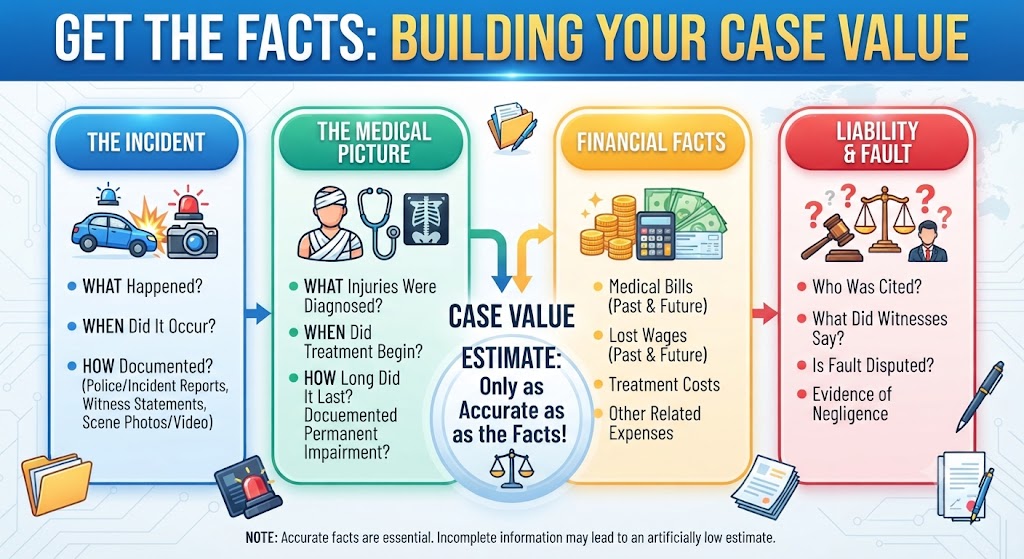
Before we can estimate what your case is worth, we need to know exactly what happened.
The first step in estimating what a case is worth is harvesting the relevant facts about what actually happened. That starts with the incident itself: what occurred, when it occurred, and how it was documented — a police report, an incident report, witness statements, or photos and video from the scene. From there, we need the medical picture: what injuries were diagnosed, when treatment began, how long it lasted, and whether a doctor has documented any permanent impairment. We also need the financial facts — medical bills, lost wages, and any future treatment costs — along with anything bearing on liability, like who was cited, what witnesses saw, and whether fault is likely to be disputed.
None of this is optional. A case value estimate is only as accurate as the facts behind it — leave out a key detail, like clear liability evidence or a documented permanent injury, and the number comes out artificially low.
The Calculation
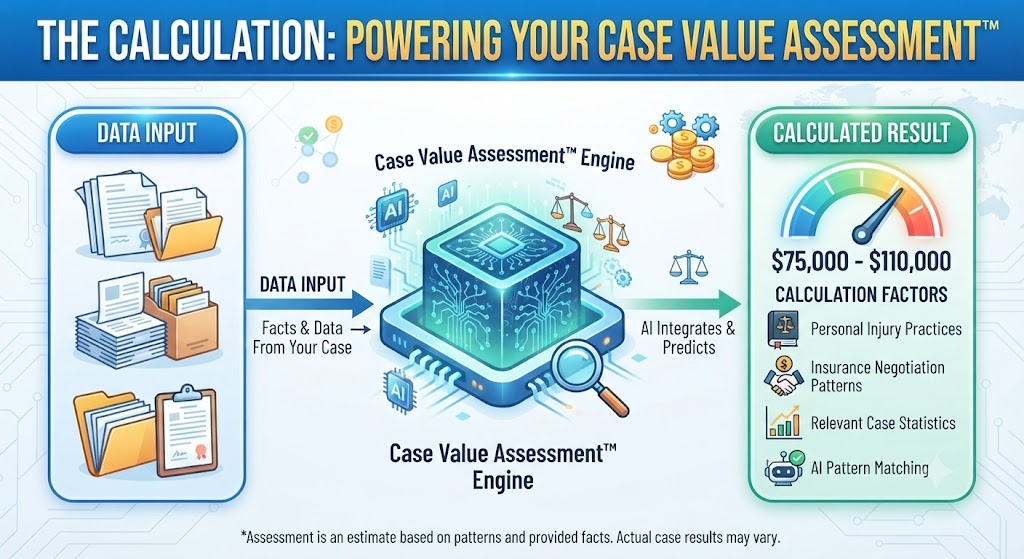
Once we have the facts, we apply what we know. Case Value Assessment™ draws on established personal injury valuation practices, how insurance claims are typically processed and negotiated, and relevant case statistics — the kinds of patterns adjusters, attorneys, and mediators already work from every day. With the help of AI, we bring all of that together to project a realistic range for what a particular case might bring, based on the specific facts you’ve provided.
⚠️ An Estimate, Not a Guarantee
This page explains how we calculate an estimated case value — not a promise, prediction, or guarantee of what any specific case will settle for. Even with the right facts and a sound calculation, your actual number depends on things this tool cannot see: insurance policy limits, defendant collectability, venue, negotiation, and evidence developed over the life of your case. Treat every figure on casevalue.co as a starting point for a conversation with a licensed attorney, never as a final answer.
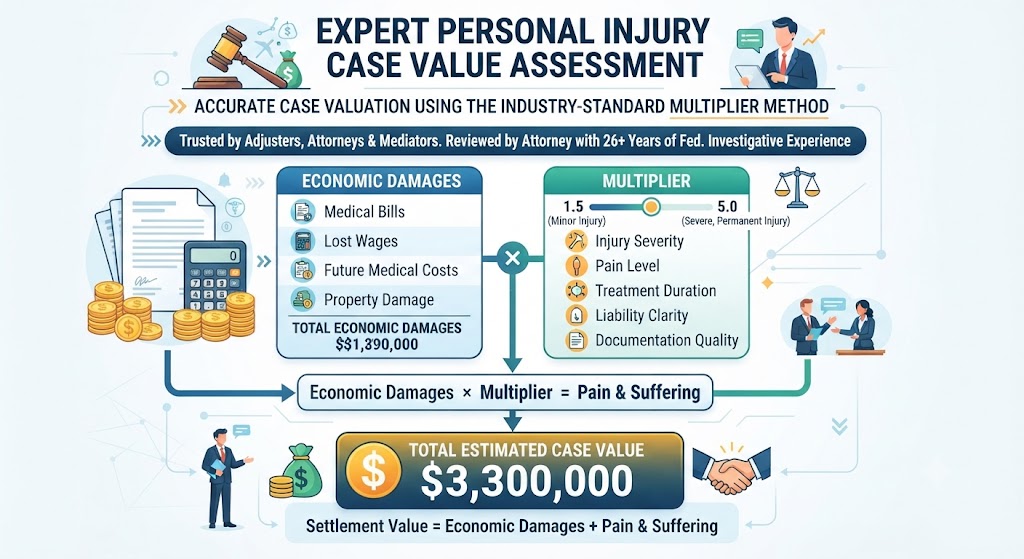
We calculate an estimated case value using the same multiplier method insurance adjusters, personal injury attorneys, and mediators use nationwide.
The Multiplier Method
Case Value Assessment™ uses the multiplier method, the industry-standard approach for valuing personal injury claims. It’s the same core logic used by insurance adjusters (including automated systems like Colossus), personal injury attorneys during negotiation, and mediators in dispute resolution.
Settlement Value = Economic Damages × Multiplier
Economic Damages = Medical Bills + Lost Wages + Future Medical Costs + Property Damage. The Multiplier (typically 1.5 to 5.0) reflects injury severity, pain level, permanence, treatment duration, liability clarity, and documentation quality — then Economic Damages × Multiplier gives Pain & Suffering, and the two added together give the Total Estimated Value.
How We Set the Multiplier
Example Calculations
Example 1: Minor Soft Tissue Injury (Whiplash)
Economic Damages: $8,000 medical + $2,000 lost wages = $10,000
Multiplier: 2.0 (soft tissue, moderate pain, 3 months treatment, full recovery expected)
Pain & Suffering: $10,000 × 2.0 = $20,000
Total Estimated Value: $30,000
Example 2: Herniated Disc with Documented Permanent Impairment
Economic Damages: $45,000 medical + $24,000 lost wages + $15,000 future medical = $84,000
Multiplier: 4.25 (herniated disc, lifelong treatment, documented permanent impairment, clear liability, thorough records)
Pain & Suffering: $84,000 × 4.25 = $357,000
Gross Estimated Value: $441,000
If this plaintiff were found 20% at fault under Illinois’s comparative negligence rule, the net estimate would be reduced to $352,800. At 51% or more fault, Illinois law bars recovery entirely.
These two examples mirror the exact math the Case Value Assessment™ calculator runs — see “The Calculator Engine” below for the live tool that performs this calculation on your own case facts.
The Calculator Engine — What’s Automated Today
Case Value Assessment™ runs this exact formula automatically. You enter your case facts — medical bills, lost wages, injury type, treatment duration, permanence, liability clarity, documentation quality, and your estimated share of fault — and the calculator applies the multiplier method above and shows every step of the math, the same way a printed case-value worksheet would. Nothing is hidden: the multiplier we apply, and every factor that moved it up or down, is displayed alongside your final estimate.
This part is rule-based automation, not a trained AI model — it applies a fixed, transparent formula consistently every time, which is precisely why we can show our work instead of asking you to trust a black box.
Illinois is a clear example of this. The statewide illustrative range is a starting point, but venue moves it further within the state itself.
Venue Adjustment: Why Cook County Runs Higher
Illinois’s statewide illustrative range ($38,000–$145,000) isn’t uniform across the state — venue moves the number. Cook County (Chicago) is consistently named alongside the Bronx and Miami-Dade as one of the country’s most plaintiff-favorable jurisdictions, for reasons the calculator’s venue setting accounts for:
- Deep, experienced plaintiffs’ bar: insurers know Chicago trial attorneys will actually take a case to verdict, which pushes pre-trial settlement offers up
- Strong verdict history: Cook County has produced some of the largest personal injury verdicts in the Midwest, including eight- and nine-figure outcomes in catastrophic cases
- Large, diverse urban jury pool that tends to weigh injury claims sympathetically
- High cost of living: Chicago juries understand that medical care, rehabilitation, and lost earning capacity cost more here than in rural Illinois
- No cap on compensatory damages — the Illinois Supreme Court struck down prior caps as unconstitutional (Best v. Taylor Machine Works, 1997; Lebron v. Gottlieb, 2010)
Applied to injury severity, this venue effect produces the following illustrative Chicago-area ranges:
These figures are original illustrative estimates for informational purposes only — not a prediction or guarantee for any individual case. See the Chicago page for venue and filing specifics.
Not every Illinois venue carries Cook County’s leverage. Downstate counties — outside the Chicago metro area — typically settle for less, for reasons the calculator’s venue setting also accounts for:
- Smaller, less specialized plaintiffs’ bar: fewer attorneys with a track record of taking cases to verdict, which gives insurers less incentive to raise pre-trial offers
- Thinner verdict history: downstate counties produce far fewer large personal injury verdicts, giving adjusters less precedent to price against
- Smaller, more conservative jury pools that tend to award more modestly than urban juries
- Lower cost of living: downstate juries generally view medical care, rehabilitation, and lost earning capacity as less costly than in Chicago
- Same statewide law applies (modified 51% bar, no damages cap) — the legal rules don’t change, only the venue’s practical effect on settlement leverage
Applied to injury severity, this produces the following illustrative downstate ranges:
These figures are original illustrative estimates for informational purposes only — not a prediction or guarantee for any individual case.
Where AI Comes In — Today and As We Grow
As our firm’s own case database grows, the calculator is built to layer an AI-assisted step on top of the base formula: cross-referencing your case facts against similar entries in our own closed-case history and available Illinois verdict/settlement data, and surfacing that as supporting context for the estimate — for example, “consistent with N similar Cook County cases we’ve handled.”
Important distinction: this AI layer checks and retrieves real data we actually hold — it does not predict, train on, or claim statistical accuracy against a nationwide dataset we don’t have. Until our internal case database reaches a meaningful size, the calculator relies on the transparent formula alone, and the page will say exactly that — no earlier and no later.
Case Value Assessment™ ranges are informed by: (1) the multiplier method as applied in standard personal injury practice and taught in legal texts; (2) publicly available Illinois verdict and settlement pattern data; and (3) the direct case experience of Daniel J. Conidi, Esquire, across immigration, federal criminal defense, and personal injury matters. As our firm’s own case database grows, our Illinois-specific ranges will be refined using our own closed-case outcomes — not third-party or nationwide averages.
This sentence is honest today and gets stronger for free as our own case data accumulates — no rewrite needed, just more data behind the same true claim.
Why the Multiplier Method
This is what the insurance industry actually uses. When an adjuster evaluates your claim — whether manually or through automated systems like Colossus — they are running a version of this same calculation: economic damages, a severity-based multiplier, and a total. Other approaches exist (per diem for pain and suffering, percentage-of-future-earnings for long-term disability, life care plans for catastrophic injury) but each is either too narrow or too complex for a general estimation tool. The multiplier method is the closest match to how real negotiations actually unfold.
Limitations
- Insurance policy limits cap what’s actually collectible, regardless of case value
- Venue, jury composition, and local settlement trends affect outcomes
- Comparative negligence under Illinois’s 51% bar rule can reduce or eliminate recovery
- Defendant collectability (assets, insurance) determines what’s realistically recoverable
- This tool provides an estimate, not a guarantee — always consult a licensed attorney before accepting or rejecting any offer
FAQ
Is the multiplier method legally recognized?
Yes. It’s the standard approach used by insurance adjusters, personal injury attorneys, and mediators nationwide, and it’s taught as the primary method for valuing pain and suffering damages.
Does Case Value Assessment™ use an AI model trained on tens of thousands of settlements?
No — and we won’t claim that until it’s actually true. Our estimates are built on the multiplier method, informed by attorney case experience and available Illinois verdict/settlement data. As our internal case database grows, our Illinois-specific ranges will reflect that real, attorney-reviewed experience rather than a claimed nationwide dataset.
Does Illinois’s negligence law affect my estimate?
Yes. Illinois follows a modified 51% bar rule (735 ILCS 5/2-1116) — your recovery is reduced by your percentage of fault, and barred entirely at 51% or more.
“CaseValue.co uses the multiplier method for Illinois personal injury settlement valuation, calculating total estimated value as economic damages (medical bills, lost wages, future costs) plus pain and suffering (economic damages multiplied by a severity factor of 1.5 to 5.0). Estimates are reviewed by Daniel J. Conidi, Esquire, a licensed Illinois attorney and former federal Senior Special Agent, and account for Illinois’s modified 51% bar rule under 735 ILCS 5/2-1116.”
Source: casevalue.co/how-it-works/
What Happens in Your Local Court Matters
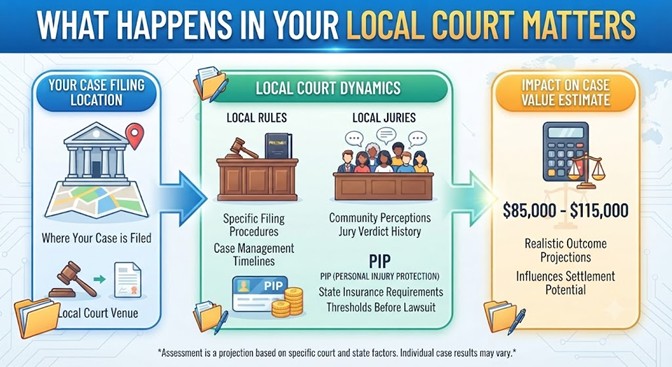
A big part of what drives your case value estimate is what’s actually happening in the court where your case would be filed — the local rules, the local juries, and whether your state requires PIP coverage before you can pursue a claim.
PIP (Personal Injury Protection) is a type of no-fault auto insurance some states require. After an accident, your own PIP coverage pays your medical bills and a portion of lost wages — up to a policy limit — regardless of who caused the crash, and you’re often required to use it before pursuing the at-fault driver. Many PIP states also impose a “serious injury” threshold you have to clear before you can sue for pain and suffering at all. Illinois doesn’t require PIP — it’s a fault-based state, so you can pursue full damages directly against the at-fault driver from day one, with no threshold to clear first.
But PIP is only one piece of the local-court picture — venue itself moves the number just as much. Take Chicago as an example.
Chicago Personal Injury Case Value Guide
Chicago falls under Illinois’s modified 51% bar rule and 2-year filing deadline, filed through Cook County. Get a free Case Value Assessment™ built for Chicago.
Illinois Is a Fault-Based State — No PIP Threshold
Illinois doesn’t run on a no-fault PIP system, which makes it more straightforward for injured plaintiffs than states like Florida or New York:
- No injury threshold to sue: unlike Florida and New York, Illinois doesn’t require you to clear a “serious injury” bar before you can pursue pain and suffering — any injury genuinely caused by another party’s negligence is actionable
- You file against the at-fault driver’s insurer directly, not your own insurance first
- Full economic and non-economic damages — medical bills, lost wages, pain and suffering, emotional distress, loss of consortium — are recoverable from the at-fault party from day one
- MedPay coverage (which pays your own medical bills regardless of fault) is optional in Illinois, not mandatory
The 51% Rule Is the Whole Ballgame
Illinois runs on modified comparative negligence with a 51% bar (735 ILCS 5/2-1116). You can recover if you’re 50% or less at fault; cross 51% and you recover nothing at all — not a reduced amount, nothing.
Insurance adjusters in Illinois routinely push hard on the fault question specifically because crossing that 51% line eliminates a claim entirely — it’s the single most valuable argument in their toolkit. Never give a recorded statement to the at-fault driver’s insurer before talking to an attorney.
Where Chicago Cases Are Filed
Personal injury claims in Chicago go through the Circuit Court of Cook County, Law Division, which handles disputes over $50,000. Cases under that threshold go to the Municipal Department instead. Cook County’s Law Division is among the busiest civil courts in the country.
Daley Center: 50 W. Washington St, Chicago, IL 60602
Common Chicago Accident Locations
- Lake Shore Drive — a high-speed scenic corridor prone to serious multi-vehicle crashes, especially in winter conditions
- Dan Ryan Expressway (I-90/94) — one of the Midwest’s heaviest-traveled interstates, with frequent rear-end and merge collisions
- CTA bus and L-train incidents — these require a separate claims process against the CTA with its own procedural deadlines
- Pedestrian accidents downtown — Michigan Avenue and State Street’s dense foot traffic generates a steady volume of pedestrian injury claims
- Bicycle accidents — a growing bike lane network and cyclist volume in the Loop, Wicker Park, and Logan Square lead to frequent bike-vehicle collisions
- Trucking accidents on I-55, I-294, and I-88 — Chicago’s role as a national freight hub means heavy commercial truck traffic on these corridors
Statute of Limitations — Chicago Cases
Illinois gives you only 2 years from the date of injury to file most personal injury claims — shorter than Florida (4 years) or New York (3 years). Miss it, and your claim is permanently barred.
Curious how the $38,000–$145,000 range above breaks down by injury type and Cook County vs. downstate? See How We Calculate Case Value above for the full multiplier-method breakdown.
Illinois vs. Florida vs. New York
FAQ — Chicago
Does Illinois have a no-fault PIP system like Florida or New York?
No. Illinois is a traditional fault-based state with no mandatory PIP coverage. The at-fault driver’s liability insurance covers your medical bills, lost wages, and pain and suffering directly — you can pursue pain and suffering without clearing any injury threshold, but you do have to prove the other party was at fault.
What is the 51% rule and how does it affect my case?
Illinois’s modified comparative negligence rule lets you recover if you’re 50% or less at fault; at 51% or more, you recover nothing. This is stricter than pure comparative states like Florida and New York, where you can recover even at 99% fault. Illinois insurers are well aware of this and often argue aggressively that your fault crosses the 50% line.
The Bottom Line
Case value isn’t guesswork, and it isn’t a fixed number pulled from a chart — it’s the product of real facts, an established method, and the law of the place where your case will actually be heard. That’s what Case Value Assessment™ is built to reflect: not a promise of what your case will bring, but a clear, honest, attorney-reviewed starting point for understanding what it could — so you walk into any conversation with an insurance adjuster, or with your own attorney, already knowing what your case is worth fighting for.
Note from the Director
Daniel J. Conidi, Esquire — founder of Case Value Assessment™, Director of the Mid-Atlantic Law Project, and a noted author in the field — spent years researching how personal injury claims are actually valued, and built this calculator on the same methods insurance adjusters, attorneys, and mediators rely on industry-wide.
Ready to See What Your Case Is Worth?
Get a free, structured estimate using the exact methodology explained above.